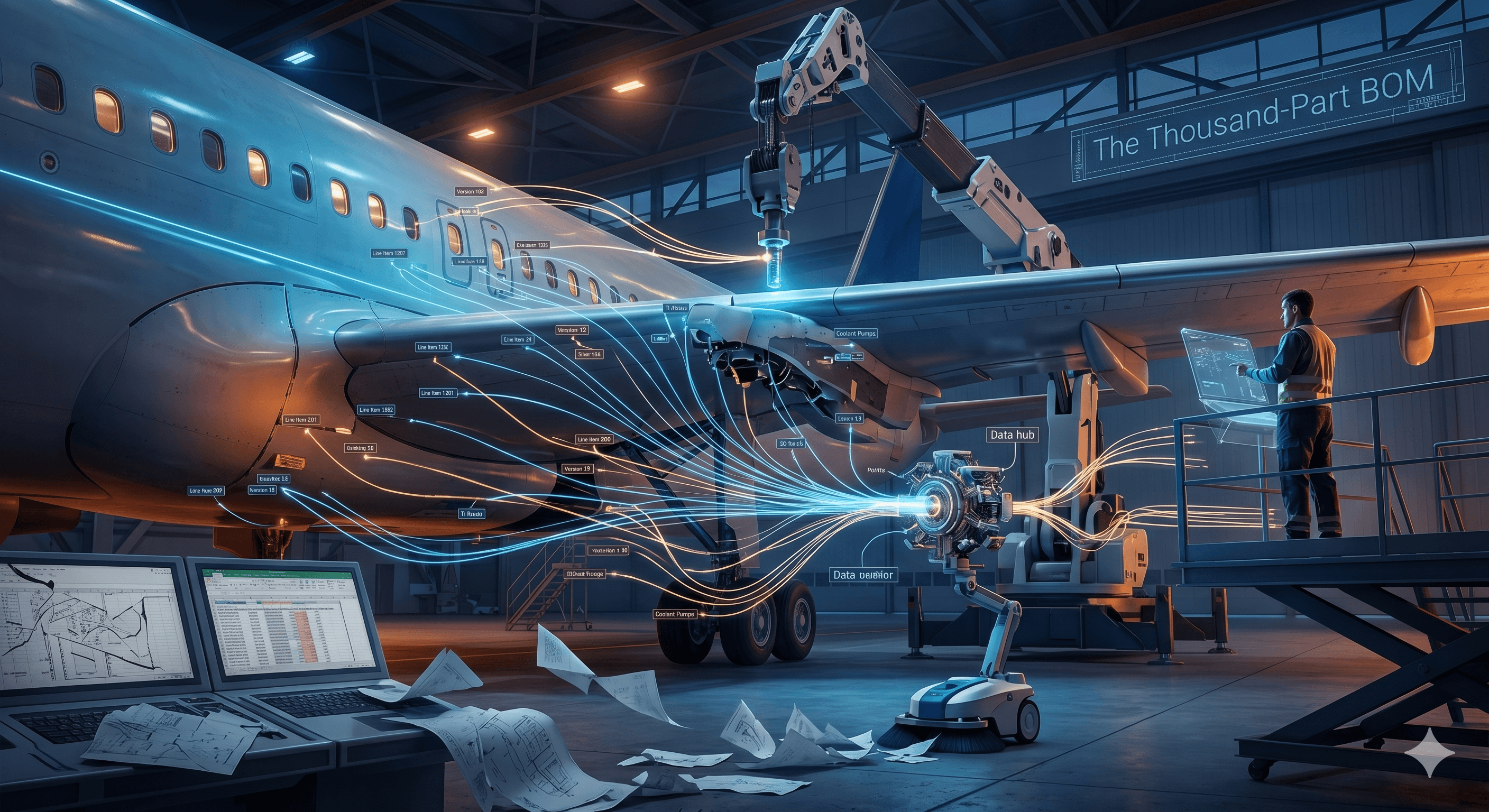
The Thousand-Part BOM
Imagine standing on the noisy shop floor of an aviation hangar, staring at a half-built commercial fuselage. The engine mounts are ready, the cranes are locked in place, but the high-tensile bolts are missing. Production stops. Why? Because a procurement officer was looking at line 842 on version 14 of an Excel sheet, while the supplier was manufacturing based on version 12.
Building an airplane isn't just about bending metal and testing aerodynamics; it is about making sure thousands of tiny, separate gears mesh together perfectly at the exact same second. When your Bill of Materials (BOM) is a thousand lines long, information doesn't just flow naturally. Without strict control, it creates a massive, catastrophic traffic jam.
Let’s step back and look at this like my Grandma looks at baking. A Bill of Materials is just a recipe. If Grandma is making a pound cake, her recipe calls for flour, eggs, sugar, and butter. If she is building a jet engine, her recipe calls for 10,000 titanium rivets, 400 miles of copper wire, and precise hydraulic pumps. If someone sneaks into Grandma's kitchen and changes the recipe from two cups of sugar to two tablespoons while the cake is in the oven, the cake is ruined. In aviation, if a supplier alters a part specification and the shop floor doesn't know, a multi-million-dollar build grinds to a halt.
So, I have to ask: Are you a highly trained aviation engineer, or have you become a Data Janitor? Are you designing safer, faster aircraft, or are you just acting as the Human Glue holding together broken communication pipes between procurement, engineering, and the assembly line?
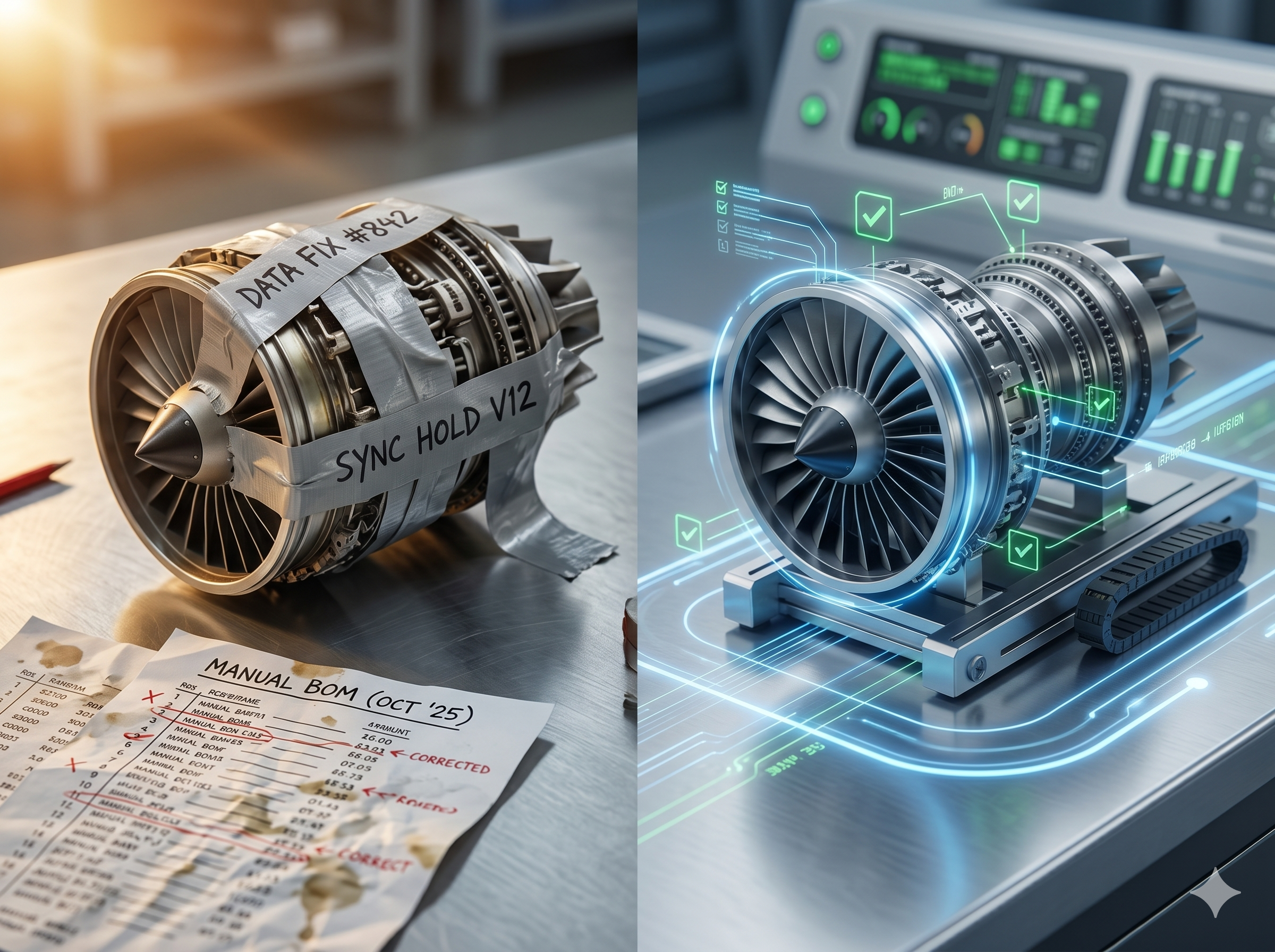 The manufacturing world is currently obsessed with "Synchronous Logic"—the incredibly flawed idea that step B must wait in a quiet, straight line for step A to manually update a system before it can move. In a thousand-part aviation BOM, synchronous logic is a death sentence for your timeline. You cannot wait for a human to manually verify 1,000 rows of data before turning the wrench.
At Peppasync, we don't sell "software" to try and make your spreadsheets look prettier. We sell a factory that finally works. We build the heavy-duty pipes that run under the floorboards of your operation.
💎 Spreadsheet Reality vs. Peppasync Reality
| Metric | Spreadsheet Reality | Peppasync Reality |
|---|---|---|
| The Blueprint | A static grid, outdated the exact second it is emailed. | A living engine, governing data continuously. |
| The Shop Floor | A noisy traffic jam where everyone is screaming for parts. | A quiet, orchestrated assembly line. |
| The Workforce | Exhausted Human Glue patching together daily miscommunications. | Engineers actually engineering. |
| The Output | Hoping the right parts show up to the right hangar. | Predictable, automated pipes that scale. |
To fix the thousand-part BOM, we have to stop treating data like a document and start treating it like raw material on a conveyor belt. You need an engine that can orchestrate the flow of every single rivet and wire.
When you inject Peppasync into your aviation supply chain, you are ripping out the fragile, human-dependent spreadsheet connections and replacing them with industrial-grade automation. We govern the data. If a supplier updates the spec on a turbine blade, the shop floor sees it instantly. The pipes route the information exactly where it needs to go, bypassing the manual bottlenecks.
Your factory was built to scale aircraft production, not to scale administrative overhead. It is time to stop sweeping up broken data and start building planes.