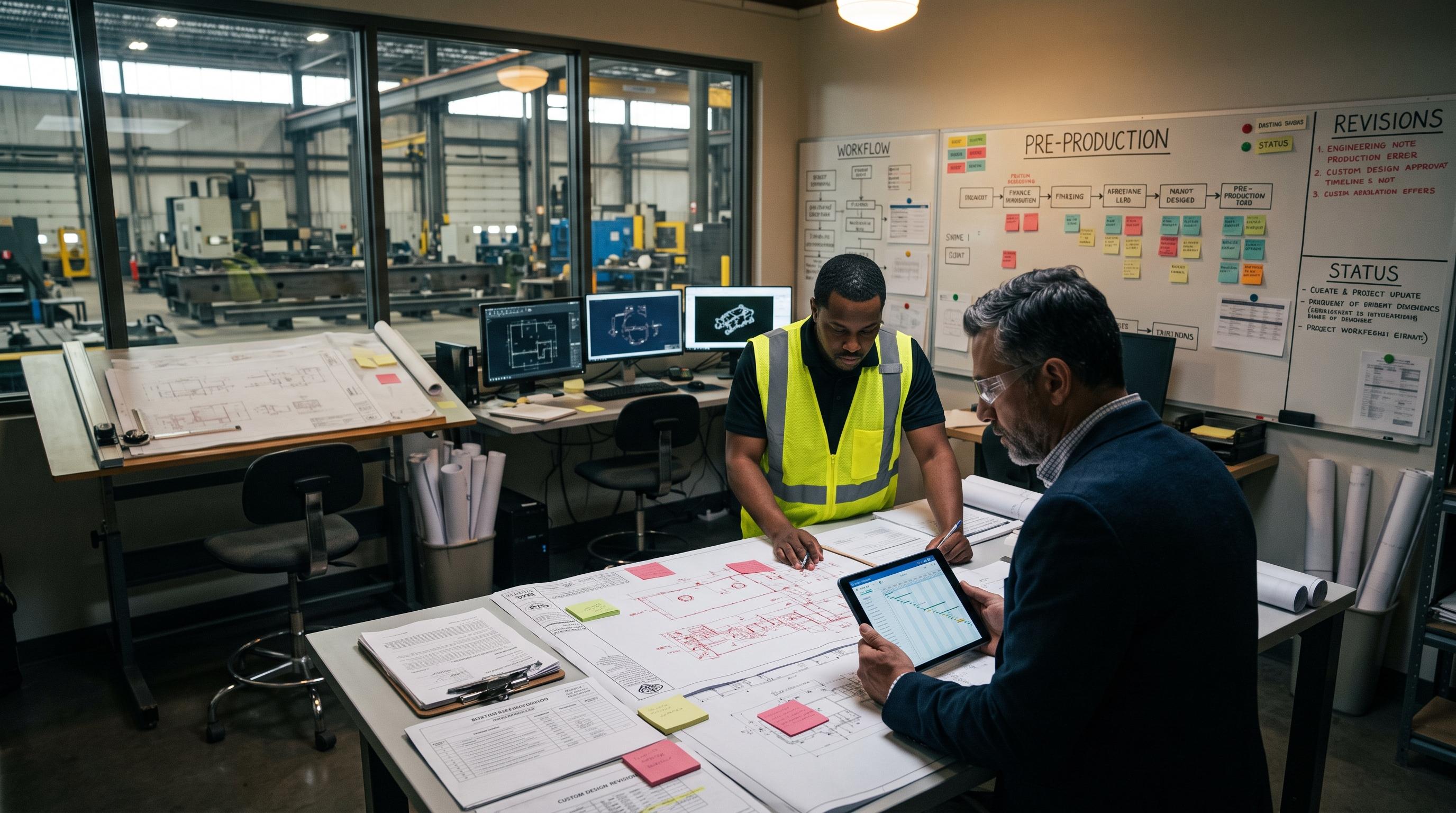
Finance leaders invest heavily in reporting tools to build leading indicators for working-capital performance. Dashboards highlight aging work-in-progress. Forecasts track expected cash inflows. Status meetings review delayed projects.
These mechanisms provide visibility. The limitation is that tracking a pre-production delay does not inherently fix it. When an order stalls in engineering or awaits an approval for weeks, simply observing the delay is insufficient. Visibility without an assigned intervention is merely the act of documenting your own margin erosion.
If the mandate from the CFO is to protect capital velocity, Finance must understand what actual intervention looks like in a custom manufacturing environment. It requires a specific operational action triggered by an order state before that state deteriorates into a financial problem.
This dynamic plays out entirely within the Pre-Factory State. This is the critical window between a customer committing to an order and that order achieving genuine production readiness. When orders stall here, working capital becomes trapped.
To protect margins and cash timing, mid-market manufacturers must recognize the specific operational drivers creating exposure and deploy targeted interventions.
1. The Revision Loop
In Build-to-Order and Engineer-to-Order environments, design changes are standard practice. A problem arises when a customer order enters an open-ended revision loop. Three engineering revisions in, the order remains far from production-ready.
The operational driver is the failure to distinguish between a standard design phase and a stalled commercial agreement.
The required intervention is to stop treating the ongoing revision as normal workflow. The manufacturer must escalate the unresolved decision, assign a definitive owner to the blocker, and establish a hard date for technical resolution.
2. Engineering Effort Consuming the Deposit
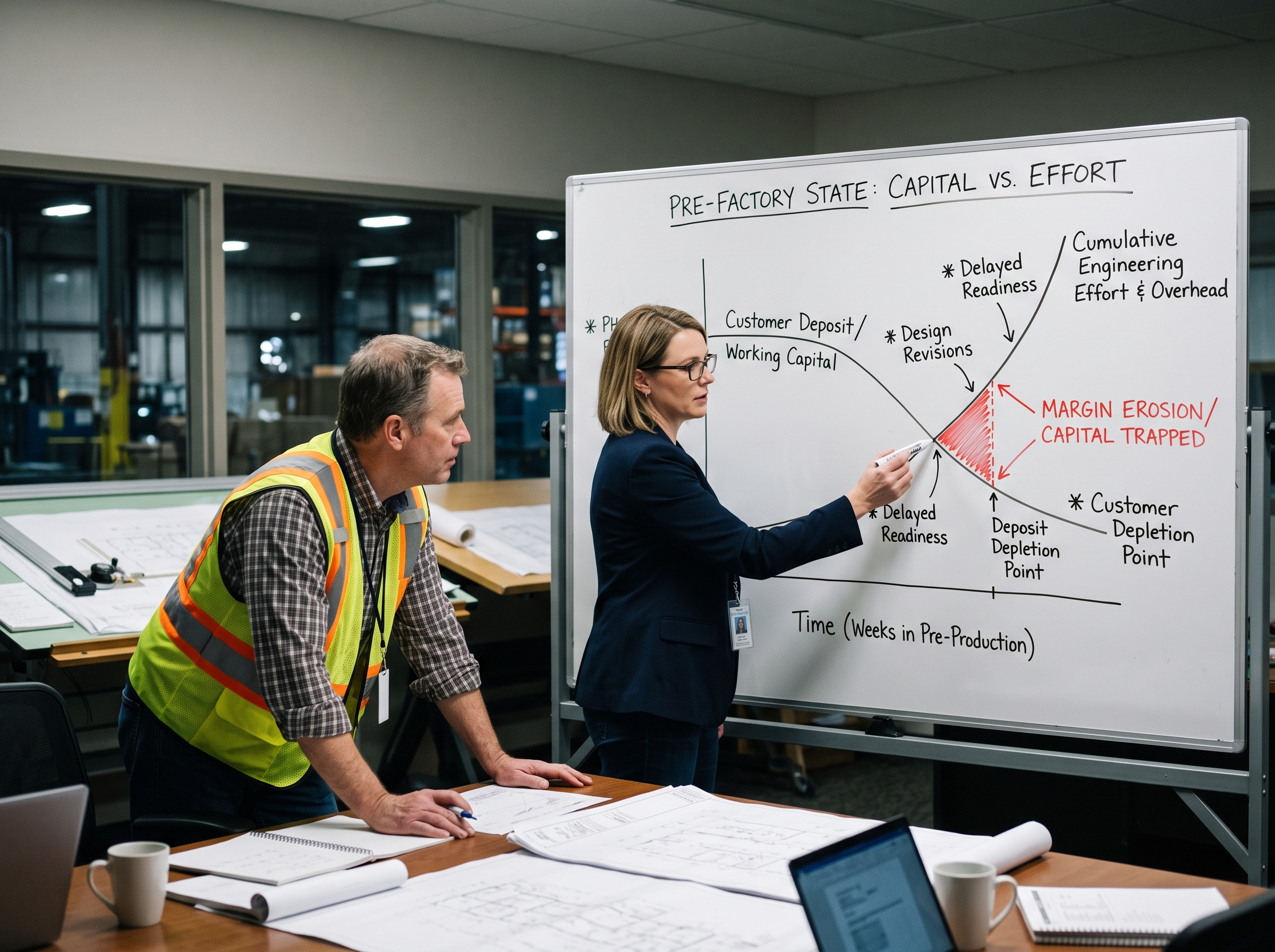
A customer deposit provides the working capital intended to fund production. When an order sits in the Pre-Factory State for an extended period, engineering hours and administrative effort continue to accumulate against the project margin.
The financial exposure grows precisely because the project is not ready for production, yet capital is actively being consumed by overhead.
The intervention requires making the remaining engineering effort completely visible against the commercial position. Finance and Operations must force a decision on whether the design work should continue, require a commercial renegotiation, or pause activity until the customer provides required information.
3. Premature Component Commitments
Procurement teams often face pressure to secure long-lead items. This can lead to a scenario where parts are ordered while specifications are still undergoing revisions.
Committing cash to components before the design is locked creates immediate working-capital exposure. If the specification changes, the manufacturer is left with redundant inventory and misallocated capital.
The intervention involves challenging the commitment at the point of origin. Operations must verify if the component is genuinely required at that exact moment or if capital is being deployed prematurely ahead of actual production readiness.
4. The Single Approval Blocker
An order may be commercially viable and technically sound, yet one unresolved approval keeps it trapped in pre-production. This could be an internal sign-off, a customer compliance check, or a missing certification document.
Without intervention, the order simply ages in the system. The production floor waits, and the capital associated with the order remains immobilized.
The intervention is to isolate and escalate the specific approval. Management must shift the focus from the general status of the order to the exact prerequisite holding it back, ensuring the individual responsible for the approval takes immediate action.
5. Crossing the Intervention Threshold
Different types of custom assemblies have standard expected durations for pre-production activity. When an order crosses its expected threshold, it indicates a breakdown in the workflow.
Relying on periodic review meetings often means this threshold is crossed days or weeks before management becomes aware of the delay.
The intervention requires a systemic trigger. Once an order spends materially longer in the Pre-Factory State than expected, it must automatically initiate a review of what is blocking it, who is accountable, and what specific action will move it forward to production readiness.
| Operational Driver | Financial Consequence | Required Intervention |
|---|---|---|
| Unresolved revision loops | Delayed production, extended cash cycle | Escalate unresolved decisions and assign ownership |
| Prolonged engineering effort | Margin erosion, deposit depletion | Evaluate accumulated effort against commercial position |
| Premature parts ordering | Misallocated cash, redundant inventory | Challenge component commitments prior to design lock |
| Missing compliance approval | Trapped working capital | Isolate and escalate the specific missing prerequisite |
| Aging past threshold | Reduced capital velocity, delayed revenue | Trigger automated review of operational bottlenecks |
The Need for Pre-Factory State Governance
Existing systems are rarely configured to enforce these interventions automatically. ERP systems are optimized for executing production and managing inventory once all parameters are known. Spreadsheets and project reports rely on manual updates and retrospective analysis.
When working capital is trapped before production begins, Finance requires a dedicated mechanism to surface the drivers.
This is the function of Pre-Factory State Governance. By adopting an operating model structured around Ingest, Govern, and Release, manufacturers can maintain persistent visibility of order states across complex pre-production workflows.
Peppasync provides this governance layer. The software ingests fragmented order information, governs the specific operational states creating financial exposure, and ensures work is only released downstream when it is genuinely execution-ready.
When evaluating declining capital velocity or extended cash conversion cycles, the solution is rarely found by analyzing financial outcomes alone. Finance leaders must evaluate the operational states creating those outcomes. The most effective way to protect working capital is to see where it is becoming trapped before production begins, then govern the bottlenecks causing it.
To understand where working capital is becoming trapped in your pre-production workflows, book a Ghost Capital Diagnostic with the Peppasync team.