AS9100 vs. Guesswork: Why Aviation Factories Can’t Afford "Digital Tape"
AI Summary (TL;DR): Aviation manufacturing requires absolute precision, but most factories are held together by "Manual Glue." Banky Alao explains how Peppasync wires the 'Buy' button directly to the factory floor, managing the 'Not-Ready-Yet' phase to eliminate errors and unstick trapped revenue.
The Law of Gravity for Your Business
The smell of JP-8 fuel and ionized air doesn't care about your "software strategy." In the aviation sector, AS9100 isn’t just a certification on a wall; it’s the law of gravity for your business. When you are building parts for a 30,000-foot environment, there is no room for "probability" or "best guesses."
When I transitioned from Electrical Engineering to Product Leadership, I saw the same ghost in every machine: Restricted Flow. In the cockpit, a pilot needs a dashboard they can trust with their life. On the factory floor, a production manager needs data they can trust with the company's survival.
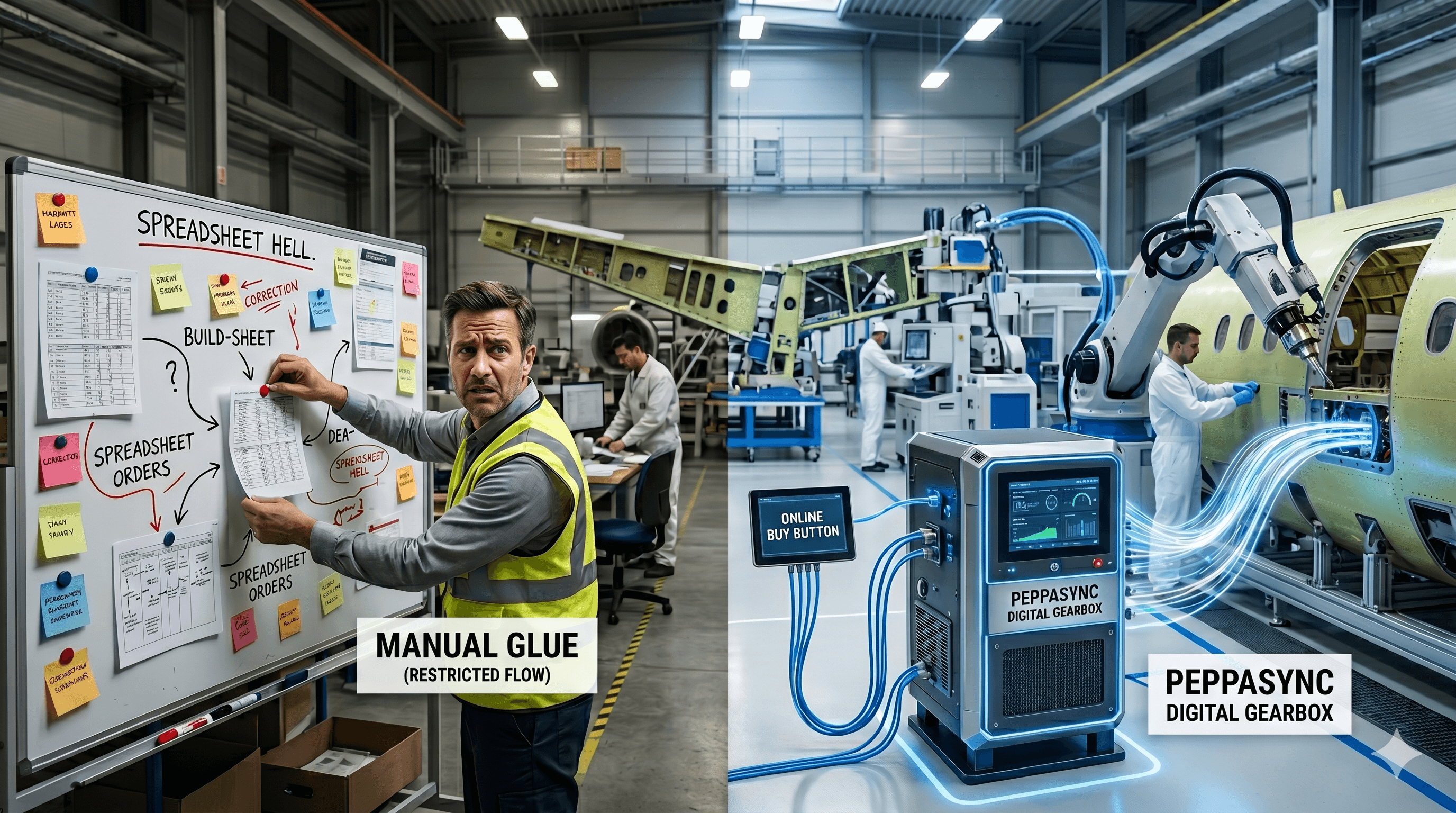
Yet, when I walk onto many aerospace shop floors, I see a terrifying reality. High-tech titanium wing spars are being managed by low-tech "Manual Glue." I see engineers—people who should be perfecting flight surfaces—spending their Monday mornings acting as Data Janitors. They are manually copying part numbers from a website into a messy spreadsheet just to keep the factory line from seizing up. This is a tax on your growth, and if you are a CFO, it’s a liability that keeps your money trapped in the pipes.
The "Guesswork" Trap: Why AI Hallucinations are a Flight Risk
Everyone is talking about AI. But most AI models are built to predict the next word in a sentence. It’s a "Best Guess" engine. In a Build-to-Order (BTO) aviation environment, a part number isn't a suggestion. If a computer "hallucinates" a maintenance record or invents a non-existent serial number, you aren't just looking at a software bug—you're looking at a grounded fleet and a massive liability for the CFO.
Most firms try to solve this by hiring more people to act as the bridge. They believe that if they just add enough "Human Glue," they can fix the mess left behind by disconnected systems. This is the Busywork Tax. It’s slow, it’s expensive, and it’s where every major mistake happens. You have a high-tech vehicle being managed by low-tech admin. It’s like putting a lawnmower engine inside a supersonic jet—it’s going to seize up the moment you try to go fast.
Digital Tape vs. The Digital Gearbox
Most aviation firms try to fix their data problems with what I call "Digital Tape." These are basic connectors (like Zapier or standard sync tools) that move information from point A to point B. They work fine for simple tasks, but they snap under the pressure of a 5,000-part aircraft assembly. These tools are "Linear"—they move data in a single-lane pipe. If one part number has a typo, the whole line stops.
At Peppasync, we don't build pipes. We build a Digital Gearbox.
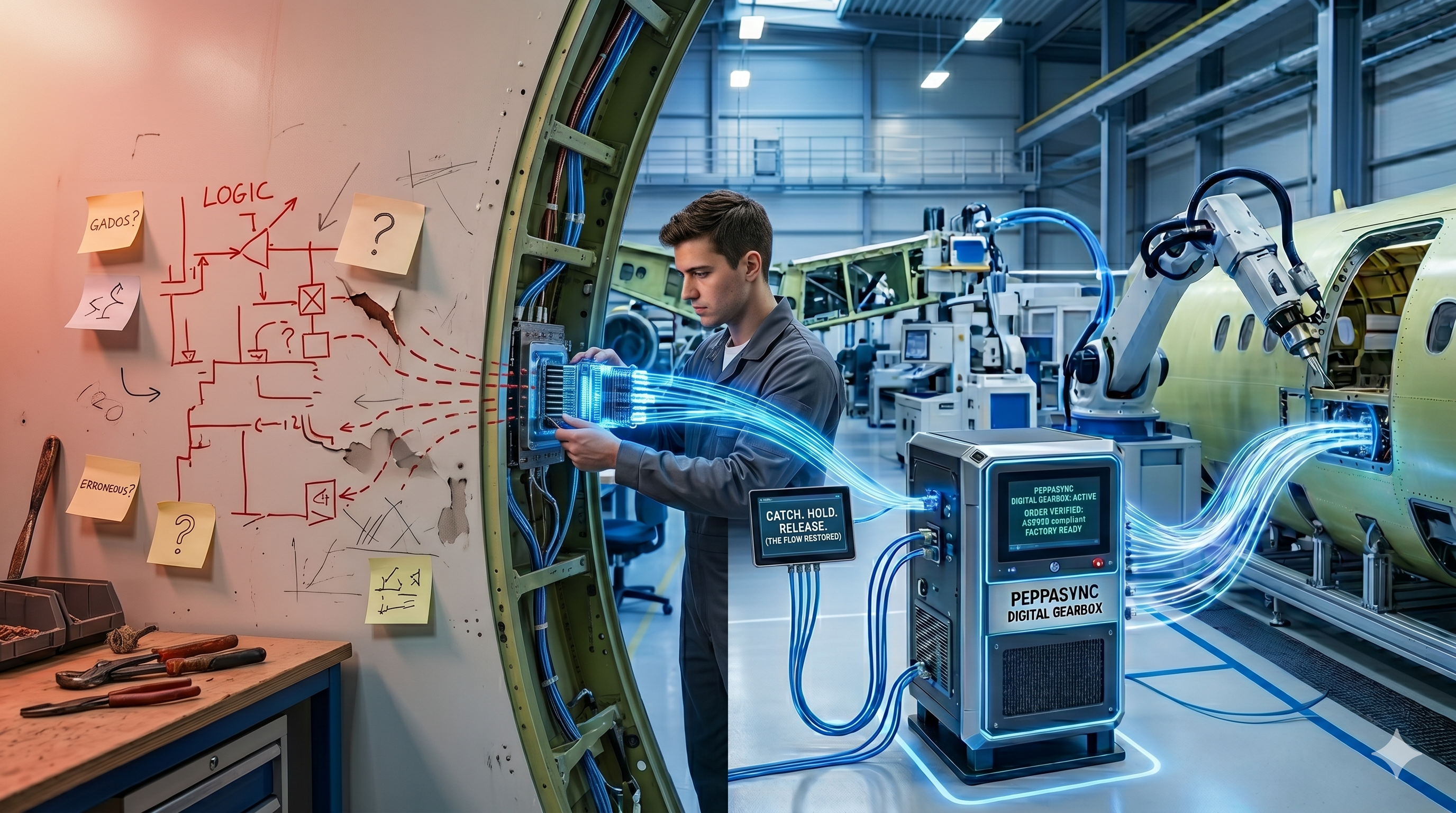
A gearbox doesn't just move power; it governs it. It understands that in aviation, an order isn't just a request—it’s a safety record. Instead of letting one bad data entry crash your entire production queue, our system identifies the error, pulls it into a holding area, and keeps the rest of the factory moving at full throttle.
The Aviation Reality Check: Governing the Flow
| The Spreadsheet Mess (Manual Glue) | The Peppasync Flow (Digital Gearbox) |
|---|---|
| Data Janitors manually fixing typos in part numbers. | Invisible Wiring that blocks errors before they hit the floor. |
| Manual Glue bridging the gap between AS9100 logs. | Automatic Flow ensuring every part is 100% verified. |
| "Admin Taxes" that stop production for audit checks. | The Cash Unclogger: Audits happen in the background. |
| They route data. | We govern time. |
Managing the "Not-Ready-Yet" Phase
The hardest handshake in commerce is the moment a customer’s custom configuration meets an aviation assembly line. If a customer chooses a specific avionics package or a custom interior trim, that data cannot "guess" its way to the technician.
Most systems try to force these complex orders through the pipe anyway, leading to "Phantom Orders"—configurations that the factory can't actually build or that don't meet safety specs. Peppasync uses a mechanical process I call Catch. Hold. Release.
- Catch: We grab the order data the second the "Buy" button is hit.
- Hold: This is the "Not-Ready-Yet" Phase. We verify the parts, the compliance certificates, and the build-sheets. We hold the order in a "digital waiting room" until it is mathematically perfect.
- Release: Only then do we wire the order directly to the factory floor.
Unsticking the CFO's Trapped Money
If you are a Finance Director in the aviation space, your nightmare is "trapped revenue." You have millions of pounds in custom orders, but you can’t recognize that revenue because the "Admin Tax" is too high. Your orders are stuck in a "Not-Ready-Yet" limbo because of a spreadsheet error or a missing part-trace.
By replacing Manual Glue with Invisible Wiring, Peppasync clears the clogs. We provide the CFO with a real-time "Gauge Cluster" that shows exactly where every order is. No more guessing. No more "Sad Day" production blowouts. Just a clean, high-pressure flow from the click to the cockpit.
The Verdict: Stop Mixing. Start Making.
Whether you are building custom EVs, luxury aircraft, or bespoke furniture, your growth is currently being held hostage by back-office busywork.
Don't wait for your next audit failure to realize your data pipes are leaking. It’s time to stop using digital tape and start using a gearbox. We wire the "Buy" button directly to the factory floor so your team can stop being Data Janitors and start being builders.
Stop mixing things up. Start making them work.