
Manufacturing Demand Is Picking Up. But How Much Working Capital Is Trapped Before Production?
UK manufacturing is showing signs of renewed momentum. The S&P Global UK Manufacturing Purchasing Managers’ Index rose to 52.8 in October, up from 51.9 in September. Its output component reached 53.6, the strongest reading since September 2024. Reuters reported that output grew at its fastest pace in more than two years and that new-order growth was the strongest since July. The survey also pointed to faster input-cost inflation and a pause in employment growth. Read the Reuters report.
For manufacturers, stronger demand is welcome. A fuller order book can support investment, utilisation and future revenue. It also raises a financial question that deserves attention before the work reaches the factory floor:
How much working capital does it take to turn that growing order book into production-ready orders?
In custom manufacturing, winning an order is the start of a process. Between customer commitment and production release, an order may pass through engineering, design revisions, customer approvals, specification checks and procurement preparation. The time required varies by product, customer and project complexity.
During that period, engineering effort can continue. Materials may be ordered or reserved. Supplier commitments may be made while specifications are still changing. A customer deposit may help fund the work, but the deposit can also be absorbed by costs incurred before production readiness.
The PMI report does not tell us how much capital individual manufacturers have tied up in pre-production. It does, however, provide a timely reason to ask how well businesses understand the working-capital requirements behind a growing order pipeline.
A delayed order is not a financial category
Consider two customer orders. Both have spent 30 days in pre-production.
The first is waiting for a routine customer approval. Engineering is complete, material commitments are limited and the order can move forward once the approval arrives.
The second has passed through several engineering revisions. Further design work is still being carried out. Components have already been committed against a specification that may change, and a customer decision remains outstanding.
An ageing report may show the same elapsed time for both orders. Their operational status may even be described using the same broad label: awaiting release.
Their financial positions can be very different.
The second order may have more engineering expenditure, greater material commitments and more uncertainty about when production can begin. That does not automatically mean the full amount is trapped cash or that a loss has occurred. It does mean the order deserves a different level of financial investigation.
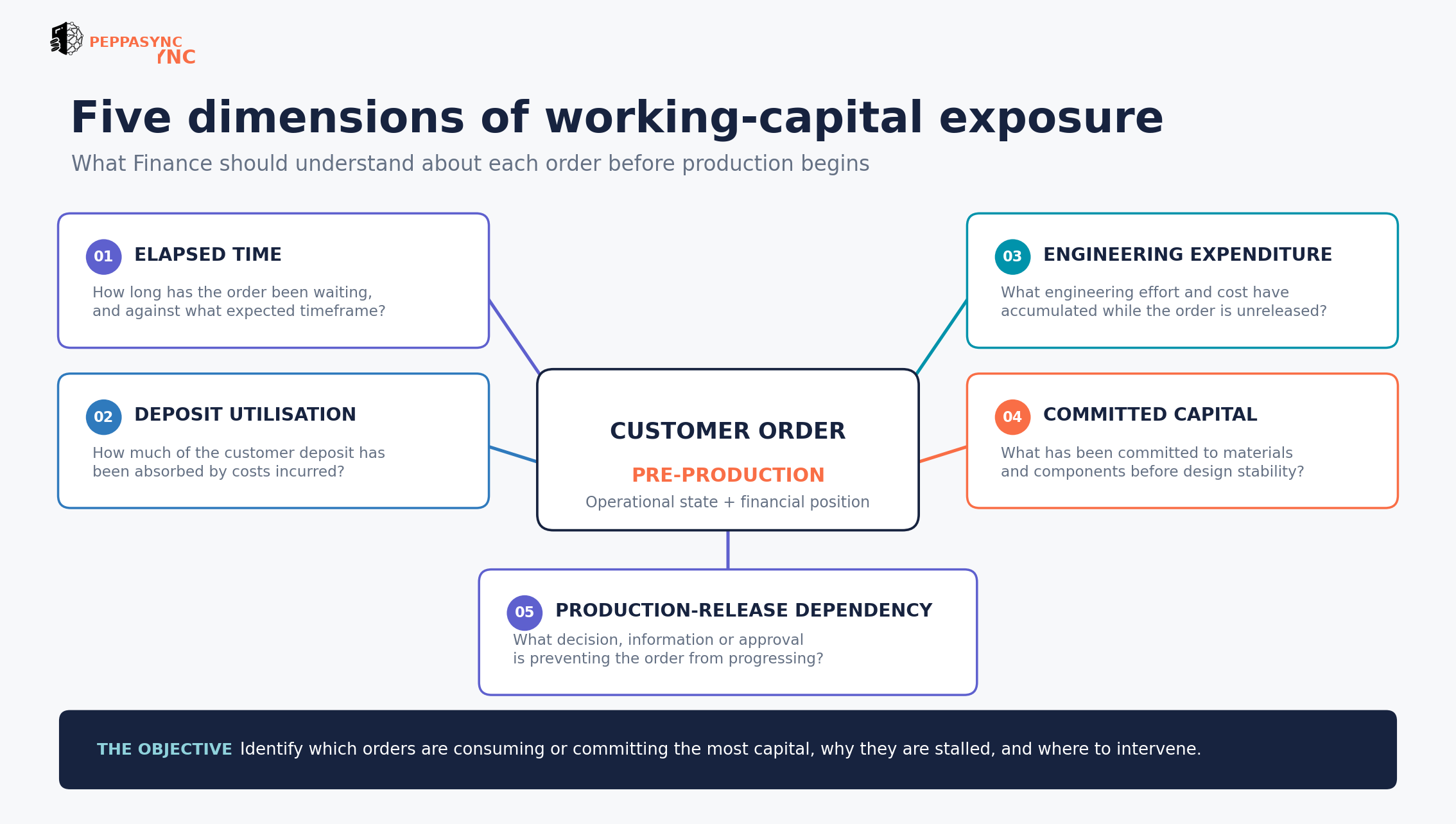
Finance needs to understand the condition of the order as well as the time it has spent waiting. Five dimensions provide a practical starting point.
Five dimensions to measure before production begins
1. Elapsed time
How long has each order been in the pre-production stage, and how does that compare with its expected timeframe?
Elapsed time provides context for everything else. A five-day approval delay may be routine for one type of order and unusual for another. The useful measure is the time spent in each meaningful state, compared with the expected duration for that order or product type.
Finance and Operations should be able to identify which orders are ageing, where time is accumulating and what event is preventing the next state transition.
2. Deposit utilisation
How much of the customer deposit has been absorbed by costs incurred before production begins?
The deposit is part of the order’s funding position. As engineering work progresses and other pre-production costs are incurred, the amount remaining to support the next stages may change.
Finance should understand the deposit received, the costs charged against the order and the remaining balance available to support delivery. The treatment will depend on the customer contract, accounting policy and the timing of cash movements. A cost recognised in the accounts should not automatically be treated as cash paid.
3. Engineering expenditure
What engineering effort and associated cost have accumulated while the order remains unreleased?
Engineering work is often necessary to fulfil a custom order. The question is whether the effort remains within the assumptions used when the order was priced and planned.
Repeated revisions, incomplete specifications or delayed customer decisions can extend engineering activity. Where that effort is not visible at order level, Finance may see the cost in a departmental total or project report without a clear view of which orders are driving it.
Tracking engineering effort against the order helps Finance and Operations investigate whether additional work is expected, recoverable through a change order, or creating exposure for the manufacturer.
4. Committed capital
What has already been committed to materials and components, particularly where the design or specification is still changing?
A commitment to a supplier is not necessarily the same as cash already paid. A purchase order, deposit to a supplier, goods received and supplier invoice represent different stages of financial exposure and should be distinguished.
That distinction matters when a design is still changing. Components may have been ordered, reserved or paid for before the final specification is stable. Finance needs to understand the nature of the commitment, whether it can be changed or cancelled, and when cash is expected to leave the business.
5. Production-release dependency
What is actually preventing the order from moving forward?
The blocker may be an unresolved engineering revision, missing customer information, an outstanding approval, an incomplete bill of materials or an internal decision. Each dependency has a different owner and a different route to resolution.
A useful order-level view connects the blocker to an accountable owner, the time it has remained unresolved and the next action required. This allows Finance to understand why the order is ageing and gives Operations a basis for deciding where intervention is needed.
Avoid adding unlike measures into one number
These five dimensions help explain an order’s financial position. They should not be added together without a clear methodology.
Deposit utilisation, engineering expenditure and committed capital can overlap. Engineering expenditure may already be included in costs charged against the deposit. A supplier commitment may be recorded in a purchase order but not yet paid. Adding these values together could double-count exposure or mix cash outflows with future obligations.
A useful assessment keeps the categories distinct:
- Cash received: the customer deposit and any subsequent receipts.
- Cash spent: payments and other cash outflows already made against the order.
- Costs incurred: costs recognised or allocated to the order, whether or not cash has been paid.
- Commitments outstanding: purchase orders and other obligations not yet settled.
- Release dependencies: the operational conditions preventing production readiness.
This gives Finance a more disciplined view of what has happened, what remains committed and what may happen next. It also creates a better basis for estimating carrying costs, cash timing and the potential financial effect of further delay.
From order reporting to pre-factory financial governance
Most manufacturers already have ways to report financial transactions and project progress. ERP records may hold customer receipts, costs, purchase orders and invoices. Project reports may show milestones, outstanding actions and delivery status.
The management challenge is connecting those views at the level of the individual order, particularly while it moves through complex pre-production states. The relevant information may sit across engineering, procurement, project management and Finance. Its usefulness depends on whether it can be brought together with consistent order context, ownership and timely updates.
This is the case for pre-factory state governance. Finance and Operations need to understand not only that an order is waiting, but what state it is in, what financial activity is taking place during that state, what is preventing progress and when an exception should trigger intervention.
Peppasync focuses on working capital management for custom manufacturing, with particular attention to capital exposed before production begins. Its role is to help bring visibility and governance to the pre-factory stage, where operational bottlenecks and financial exposure can develop before production readiness.
The CFO question as manufacturing demand grows
A stronger order pipeline can create opportunities for manufacturers. It can also increase the number of orders moving through engineering, approvals and procurement before production begins.
The financial position of those orders will vary. Some may be progressing as planned. Others may be consuming engineering effort, using customer deposits or accumulating material commitments while waiting for a decision.
The practical question for Finance is straightforward:
Can you see, at individual order level, how long capital has been exposed before production begins, what has been spent or committed, and what is preventing release?
Two orders can be equally delayed and carry very different working-capital exposure. Understanding that difference gives Finance and Operations a stronger basis for prioritising attention, challenging assumptions and intervening while there is still an opportunity to influence the outcome.