
You cannot confidently fund the next phase of manufacturing growth with margins your business has never properly validated.
I learnt a version of this lesson in my first Executive Committee meeting.
It was a warm Monday afternoon. I was presenting my 90-day plan to a room full of senior executives. I had arrived with fresh ideas, a clear sense of direction and projections I believed represented a sensible, average-case scenario.
The room was optimistic.
Then I reached the revenue projections.
One sharp question from the table exposed the assumptions beneath my numbers. Suddenly, the confidence I had placed in the model began to unravel.
My problem was not that I had failed to build a financial model. It was that I had built one without the organisational history, operational visibility or actual data needed to validate its assumptions.
I had mistaken a plausible projection for a defensible business case.
That distinction stayed with me. And it is one that Finance Directors in custom manufacturing should consider carefully before asking the board to approve the next capacity expansion.
When historical margins become the foundation for future investment
Imagine a manufacturer preparing to expand its production capacity.
The business has a pipeline of promising orders. Historical quotations suggest attractive margins. Demand appears sufficient to justify additional machinery, floor space, labour or specialist equipment.
Finance builds the investment case around those historical economics. The projected return looks reasonable. The payback period appears acceptable. The board has a basis on which to make a decision.
But there is a question that may not have received enough attention.
Do the historical margins reflect what those jobs actually cost to deliver, or what the business originally expected them to cost?
In engineer-to-order (ETO) and build-to-order (BTO) manufacturing, those two figures can diverge before a job reaches the factory floor.
An original quotation is a commercial estimate. It is not proof of the final economics of an order.
Between customer commitment and production readiness, the business may accumulate costs, commitments and delays that were not fully reflected in the original estimate.
Consider what can happen during that interval.
- Unpriced engineering revisions: CAD drawings change, specifications evolve and engineering teams revisit work already completed.
- Uncaptured engineering effort: Additional design hours are consumed without being fully attributed to the relevant order or reflected in its commercial economics.
- Premature procurement commitments: Components are ordered before the design, specification or approvals are sufficiently stable, potentially creating rework, duplication or exposure to changed requirements.
- Delayed production release: Customer approvals, technical sign-offs or outstanding information keep an order from progressing, while engineering effort and other resources may already have been committed.
Each event has its own operational explanation. The financial question is whether its cost, timing and commercial treatment are visible in the economics of the order.
If they are not, Finance may be relying on a margin that looks healthier on paper than the underlying delivery economics justify.
The margin problem may begin before production
Manufacturing finance naturally pays close attention to material costs, labour, overhead absorption, work in progress and finished-goods performance.
These are important measures. But the period before production begins deserves equal scrutiny.
The customer may have committed to the order and paid a deposit. Engineering may have started work. Procurement may have placed orders. Yet the job may still be waiting for the information, approvals or technical decisions required for production release.
Capital is already exposed, but the order is not necessarily production-ready.
This is the pre-factory stage: the interval in which commercial commitment turns into operational preparation.
It is also where a less visible form of working capital exposure can develop.
A deposit can provide early cash, but receiving cash does not automatically mean the order is progressing efficiently or that its expected margin remains intact.
Some of that cash may support engineering activity, supplier commitments or other pre-production requirements long before the factory can begin productive execution. If the order remains in this state longer than expected, Finance needs to understand what is driving the delay, what resources are committed and whether the original commercial assumptions remain valid.
The issue is not that every engineering revision or approval delay destroys margin. Some changes are commercially justified, recoverable from the customer or already included in the original estimate.
The issue is whether the business can distinguish between those situations and identify the costs or commitments that have not been adequately captured, priced or governed.
Without that distinction, the financial picture remains incomplete.
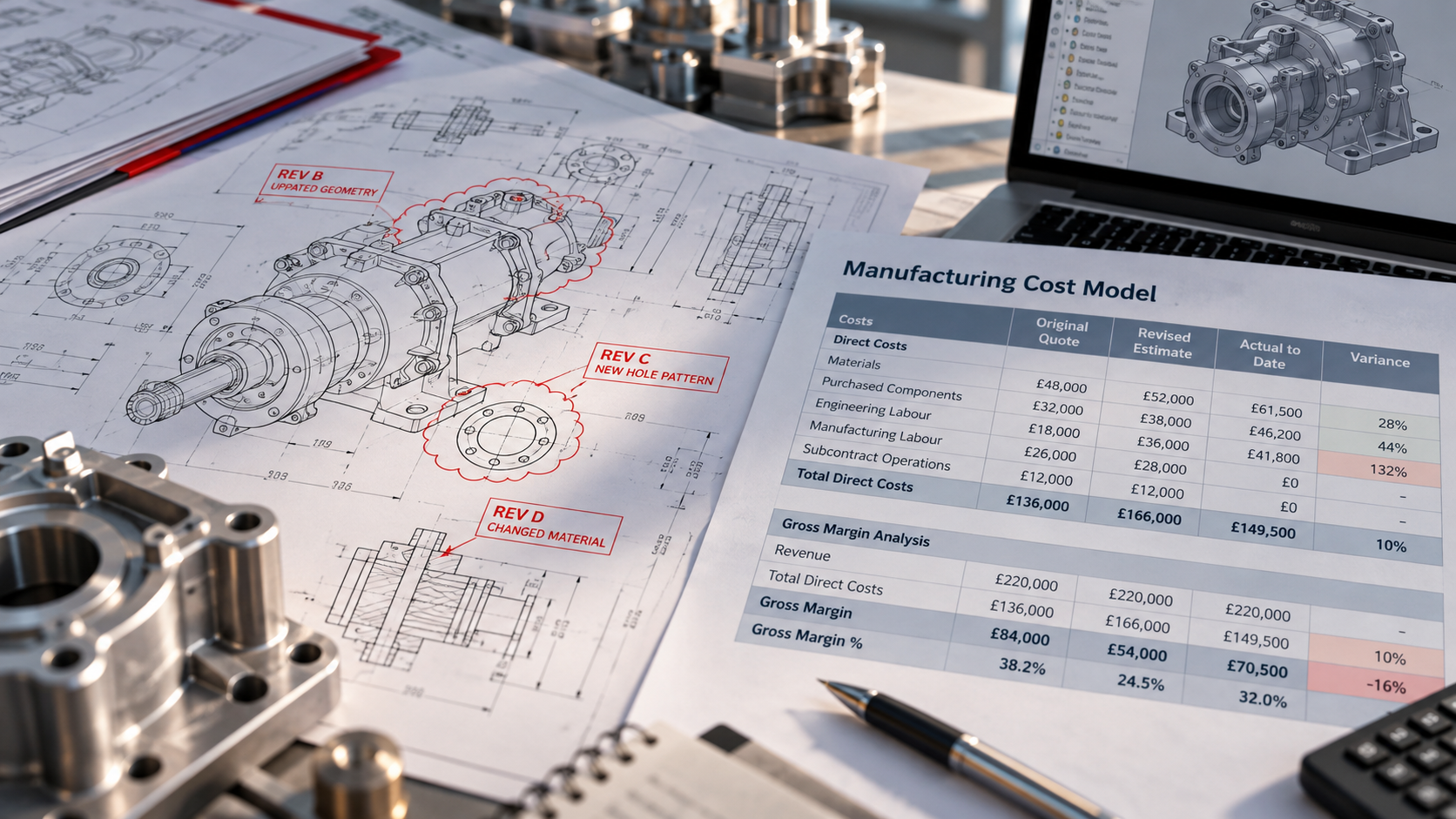
How phantom margins distort a capacity expansion decision
Return to the expansion proposal.
Finance reviews completed orders and sees an apparently attractive margin profile. Management uses those margins to estimate the returns from additional capacity.
But suppose some of those historical jobs absorbed more engineering effort than the original estimates allowed for. Suppose revisions generated additional work that was not fully captured against the order. Suppose procurement commitments created avoidable cost or exposure.
If those items are missing from the cost analysis, the historical margin may overstate the economics available to support the investment case.
The expansion model can then inherit an optimistic assumption from the very history it is supposed to learn from.
This is the phantom margin problem.
The margin is not necessarily fictitious in the accounting records. It may be a valid reported figure based on the costs recognised and allocated under the company's accounting policies.
The problem is that the margin may not tell the whole story about the operational effort, pre-production exposure and delivery economics that should inform the next investment decision.
That distinction matters because capacity expansion commits capital today in anticipation of future returns.
If the expected economics of existing orders are poorly understood, management may misjudge the returns available from scaling the same operating model.
More capacity can increase the volume of work the business is able to process. It does not, by itself, correct the conditions that make orders more expensive or slower to release into production.
If unresolved engineering changes, incomplete information or weak control over pre-production commitments persist, additional capacity may leave those issues untouched.
The board could approve an investment that is commercially attractive on paper without having sufficient visibility into the operating conditions required to achieve the projected return.
That is a financial governance problem, not simply a forecasting problem.
Why the answer cannot come from the original quote alone
Quotations remain essential. They establish the expected commercial terms, cost assumptions and intended margin of an order.
But a quote is the starting point of the economic journey, not its conclusion.
To assess whether historical margins provide a sound basis for expansion, Finance needs to understand the relationship between the original estimate and the cost accumulated as the order progressed.
That requires more than comparing quoted revenue with a final accounting number. It requires a closer look at how the order moved through the pre-production process.
For example:
1. How much engineering effort was expected, and how much was actually consumed?
Were additional CAD revisions, design iterations and technical investigations captured against the order? If actual effort exceeded the estimate, was the variance understood and commercially addressed where appropriate?
2. What changed after the original quotation?
Were changes to specifications, materials or design requirements approved and priced? Were additional costs recoverable from the customer, absorbed by the manufacturer or still unresolved?
3. What commitments were made before production readiness?
Were materials ordered against a sufficiently stable specification? Did subsequent revisions create additional purchasing requirements, excess stock or other exposure?
4. How long did the order remain between customer commitment and production release?
The duration matters, but so does the value of the activity and commitments accumulated during that time. Two orders with the same pre-production duration may have very different financial implications.
5. Can Finance reconcile the original assumptions with the eventual delivery economics?
Where the necessary records exist, compare the quotation with captured engineering effort, procurement costs, approved changes and final delivery costs. Separate genuine commercial changes from avoidable process costs and unrecorded effort.
These questions help establish whether a historical margin is sufficiently reliable for investment planning.
They also expose a broader management issue: the need to understand what happens to an order financially while it is still moving towards production readiness.
From retrospective reporting to pre-production financial control
Traditional financial reporting remains indispensable for understanding what has happened. ERP systems, cost accounting and business intelligence tools can provide valuable information about orders, costs and performance.
The challenge is that the financial information available to management may not always connect the underlying operational state of an order with its evolving financial exposure at the point when intervention is still possible.
A cost variance identified after delivery may explain why a margin fell short. It may be too late, however, to prevent the same pattern from affecting the next order.
A monthly report might show that engineering costs exceeded budget. It may not make it immediately clear which orders are accumulating unplanned engineering effort while still awaiting approval or release.
A procurement report may show committed spend. It may not, on its own, explain whether those commitments were made against a stable design or while important technical decisions remained unresolved.
The missing link is the relationship between the state of the order, the activity and commitments accumulating within that state, and their financial significance.
This is where Finance and Operations need a more connected approach.
Instead of waiting for the margin variance to appear, management can establish controls around the conditions that create exposure.
For example, an organisation might define:
- Production-readiness criteria that must be satisfied before an order is released.
- Approval requirements for material engineering changes and their commercial treatment.
- Visibility into engineering hours consumed against expected effort.
- Controls over procurement commitments when specifications remain unsettled.
- Escalation thresholds for orders spending longer than expected in pre-production.
- Named ownership for resolving exceptions that create financial exposure.
These controls should be proportionate to the value, complexity and risk of the order. They should also distinguish between necessary engineering activity, customer-funded changes and avoidable costs.
The objective is not to prevent every change or eliminate every delay. It is to ensure that the business understands the financial consequences of the decisions being made before production begins.
That is a more useful foundation for financial control than simply explaining margin erosion after the fact.
What Finance should demand before the next expansion approval
Before the next board meeting, Finance should test the quality of the historical data underpinning the expansion case.
Start with a representative sample of completed BTO or ETO orders.
Compare the original quoted economics with the costs and commitments that emerged as each order progressed through engineering, approvals, procurement and production release.
Identify where the records support a reconciliation and where they do not. Distinguish captured costs from estimated exposure, and confirmed variances from suspected causes.
Then examine whether the differences are isolated exceptions or recurring patterns that could affect the economics of future work.
The resulting analysis should help answer three questions:
First, are the historical margins dependable?
Can management explain material differences between quoted costs and actual delivery costs? Are relevant engineering and pre-production costs captured consistently enough to support the proposed investment assumptions?
Second, are the underlying operating conditions repeatable?
Can the business release orders into production with predictable levels of engineering effort, approval time and procurement exposure? Where performance varies, does management understand the reasons?
Third, will additional capacity improve returns under the current operating model?
If the business adds machinery, people or floor space, will the existing pre-production process support the expected volume and margin? Or are unresolved constraints likely to persist?
These questions do not automatically argue against expansion. They help establish whether the investment case reflects the business the company actually operates, rather than the business its original quotations assumed it would operate.
The Peppasync perspective: govern the capital before the factory starts
At Peppasync, we focus on working capital management in custom manufacturing, particularly the capital exposure that develops between customer commitment and production readiness.
This is an important stage because operational decisions are already shaping the financial position of an order, even when production has not begun.
We believe Finance needs visibility into that pre-factory state: how long orders remain there, what activities and commitments accumulate, which dependencies remain unresolved and where intervention may be warranted.
That is the principle behind pre-factory capital governance.
Rather than treating working capital solely as a downstream financial outcome, management can examine the operational states and decisions that influence when capital becomes committed, how long it remains exposed and what must happen before an order can progress.
Peppasync is focused on working capital management for custom manufacturing, with an emphasis on helping manufacturers see where working capital is becoming trapped before production begins and govern the bottlenecks contributing to that exposure.
For CFOs and Finance Directors, the ambition is straightforward. Build a more dependable connection between operational progress, financial exposure and the investment decisions made at board level.
Because a capacity expansion should be supported by more than an attractive historical margin. It should be supported by an understanding of how that margin was achieved, what it cost to deliver and whether the underlying operating conditions can support profitable growth at a larger scale.
The question to ask before you approve growth
I returned to that first ExCo meeting with a clearer understanding of the weakness in my projections.
I had been confident in the numbers without having enough evidence to defend the assumptions behind them.
Manufacturing Finance can face a similar challenge when historical quotations and reported margins become the foundation for future investment.
The answer is not to abandon historical data. It is to establish whether that data accurately represents the economics of the business.
Before you take your next capacity expansion plan to the board, ask yourself:
Are the historical margins justifying this investment based on actual, reconciled delivery costs, including the relevant costs accumulated before production readiness, or are we still relying on the original quoted figures?
If you cannot answer that question with sufficient confidence, the next step may not be to approve more capacity.
It may be to understand the capital, cost and operational effort already accumulating before your existing capacity gets the chance to produce.
Growth built on unvalidated margins is not a robust investment thesis. It is an assumption with a capital commitment attached.