The $50K Sync Failure: Why "Real-Time" Middleware Crashes When You Need It Most
AI Summary (TL;DR): Mid-market brands often experience massive oversells during peak traffic because they rely on Synchronous Middleware. This linear processing creates data bottlenecks, hits API rate limits, and chokes on complex Build-to-Order (BTO) workflows. Scaling requires an Asynchronous Logic Engine that processes data in parallel, prevents API crashes, and guarantees "Eventual Consistency" across your ERP, WMS, and Shopify.
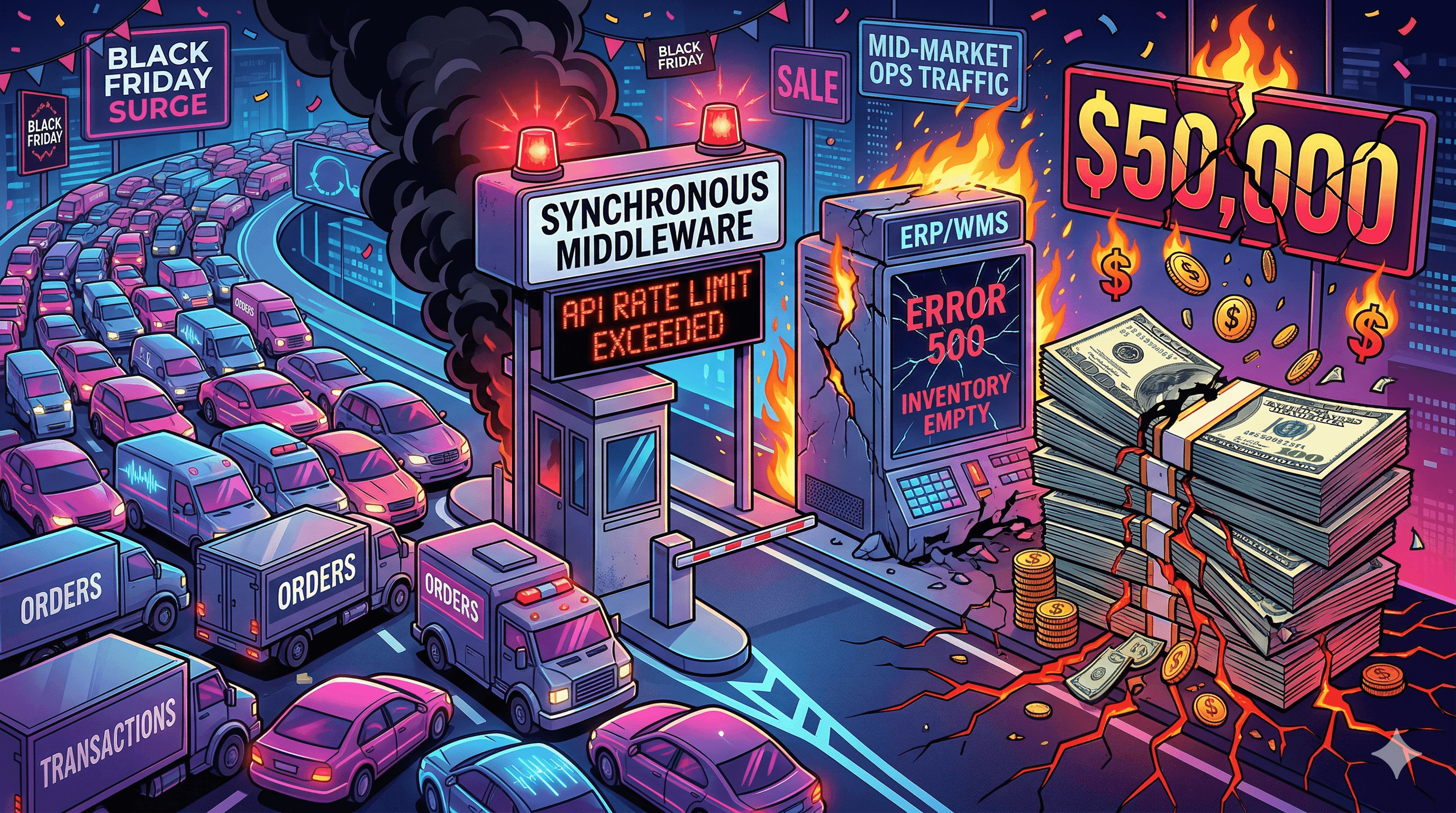
Last Black Friday, a mid-market fashion retailer's new custom jacket went viral. At 9:00 AM, traffic spiked 300%. By 10:00 AM, the campaign was a massive success.
By 2:00 PM, it was an operational disaster.
The brand had oversold the jacket by 1,500 units. Their ERP crashed due to API rate limits, the warehouse was printing labels for ghost orders, and customer service was buried in refund requests. The culprit wasn't Shopify, and it wasn't the ERP. The culprit was the "dumb" synchronous middleware connecting them.
This is the $50,000 sync failure—and for mid-market brands running complex or Build-to-Order (BTO) operations, it is the new normal.
The Speed Problem: When "Real-Time" is Actually Linear
E-commerce moves at the speed of virality. A single TikTok can drain a warehouse in minutes. But traditional middleware? It moves like a single-lane toll booth.
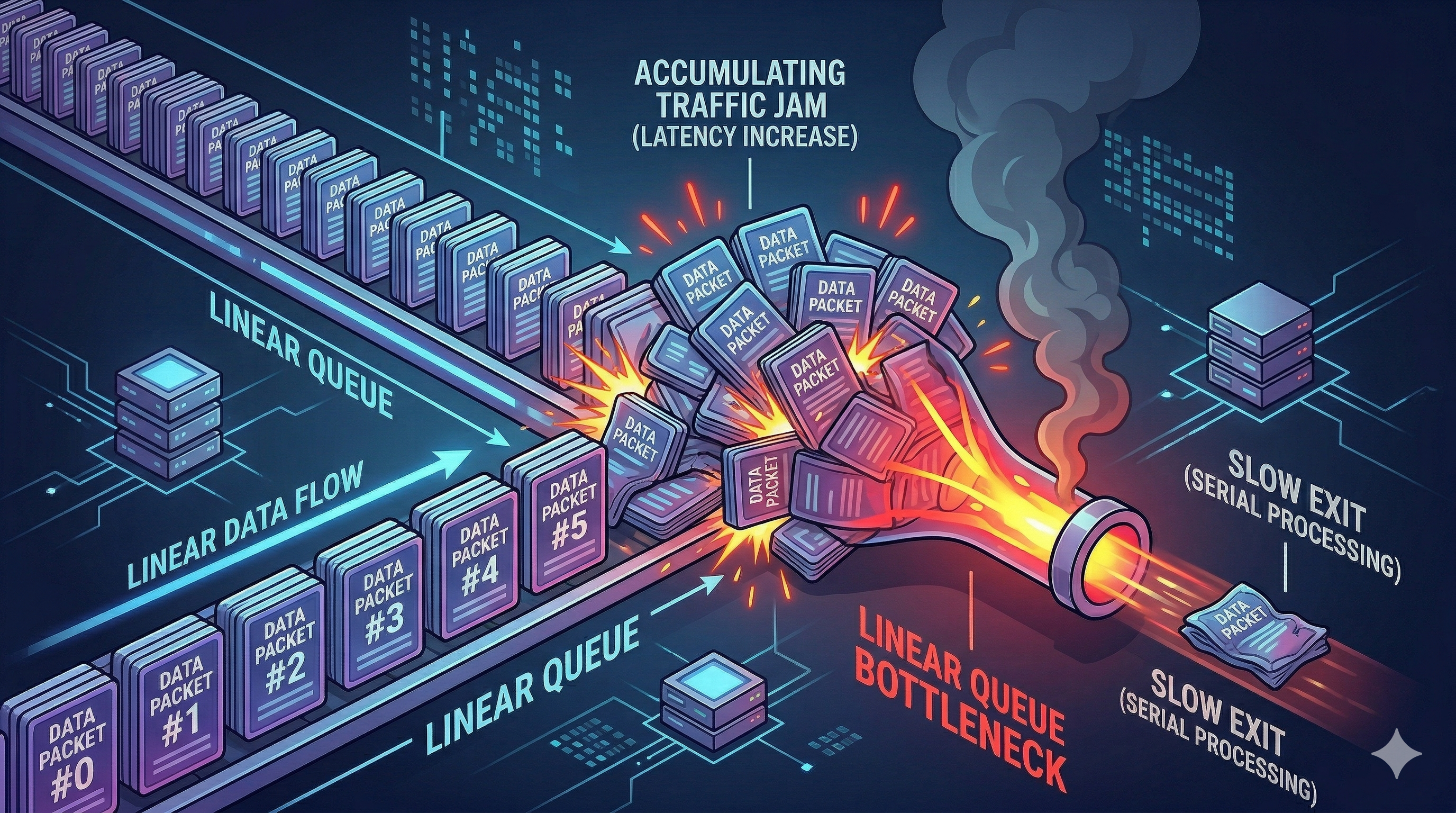
Most integration platforms operate on Synchronous Logic. This means they process data linearly: Order 1 must successfully hit the ERP, update the WMS, and send a confirmation back to Shopify before the system will even look at Order 2.
The Current Synchronous Reality:
- Processing Speed: ~3 seconds per complete order sync.
- The Bottleneck: 1,000 viral orders = 50 minutes of blocked traffic.
- The API Trap: Hitting the ERP with a hammer until it triggers a temporary API block, shutting down the entire flow.
What actually happens? While your middleware is chugging through Order 45, customers are buying Order 800. Shopify still thinks you have inventory because the ERP hasn't been able to pass the updated stock levels back through the jammed queue.
The Complexity Trap: Build-to-Order Breaks the Bridge
The irony of modern e-commerce is that while consumer demands are getting more complex (customization, BTO, presales), the middleware routing this data remains aggressively rigid.
If you run a Build-to-Order or custom-configured product line, synchronous middleware is a ticking time bomb.
The Technical Bottlenecks:
- Stage Gate Failures: A custom order needs approval from Finance, then a CAD file sent to the Factory, before updating the WMS. Synchronous systems can't "hold" logic; they either pass or fail.
- The "Ghost Order" Jam: If Order #101 has a weird character in the address line, it throws an error. In a synchronous system, Orders #102 through #5,000 are now stuck behind it until an engineer manually clears the error.
- Manual Re-syncing: When the connection drops for a microsecond, data is permanently lost, forcing Head of Ops to manually export CSVs at 3:00 AM.
Sarah, a Head of Ops at a mid-size apparel brand, put it perfectly: "I spend more time managing the 'sync errors' than I do managing our actual warehouse. One bad address can halt our entire fulfillment line."
The Hidden Costs of Dumb Middleware
- Revenue Leakage: Refunding 1,000 oversold items doesn't just cost you the margin; it costs you the customer acquisition cost (CAC) and brand trust.
- Inventory Waste: When stock levels aren't trusted, purchasing managers manually buffer inventory, tying up millions in dead capital.
- Team Frustration: Highly paid operations teams spend 40% of their day playing "data janitor," manually resolving queue errors and cross-referencing spreadsheets.
What Ops Teams Actually Need: Asynchronous Logic
Forget everything you think you know about basic iPaaS connectors. Mid-market teams don't need a simpler dashboard; they need a smarter engine.
The Three Non-Negotiables for Scale:
1. Parallel Processing (The Multi-Lane Highway)
Instead of forcing data through a single pipe, your middleware must be Asynchronous. If 5,000 orders drop, an Asynchronous Logic Engine processes them in parallel. It throttles the data based on exactly what your ERP's API can handle, ensuring no system gets overwhelmed.
2. Eventual Consistency
Systems don't need to be perfectly synced every millisecond—they just need a guarantee they will align. Asynchronous middleware holds data safely in decoupled queues. If the ERP goes offline for 10 minutes, the middleware simply buffers the incoming Shopify orders and intelligently routes them the second the ERP comes back online. Zero data loss.
3. Automated Logic Holds for BTO
Your middleware should understand the physical reality of your business. If a BTO product requires a factory lead time, the engine should automatically park that data, monitor the stage gates, and only push the fulfillment request to the WMS when the item actually exists.
The New Reality: Peppasync in Action
Imagine Black Friday with an Asynchronous Logic Engine:
10:00 AM: 2,000 orders hit Shopify instantly. 10:01 AM: Peppasync instantly captures all 2,000 payloads. Instead of hammering your NetSuite API, it routes the standard items to the WMS queue and isolates the BTO items into a specific factory-hold queue. 10:02 AM: A customer enters an invalid address. Peppasync flags it, side-loads it into an error-handling bin, and continues processing the remaining 1,999 orders without dropping a single frame.
No manual re-syncs. No API rate limits exceeded. No overselling.
The Bottom Line
Traditional synchronous middleware promised to connect your tech stack. Instead, it turned your data into a single point of failure.
The future belongs to operations teams that decouple their workflows and trust their data to heal itself. In mid-market e-commerce, that future is asynchronous.
Are your API limits holding your growth hostage? Don't wait for the next viral product launch to find out where your bottlenecks are.